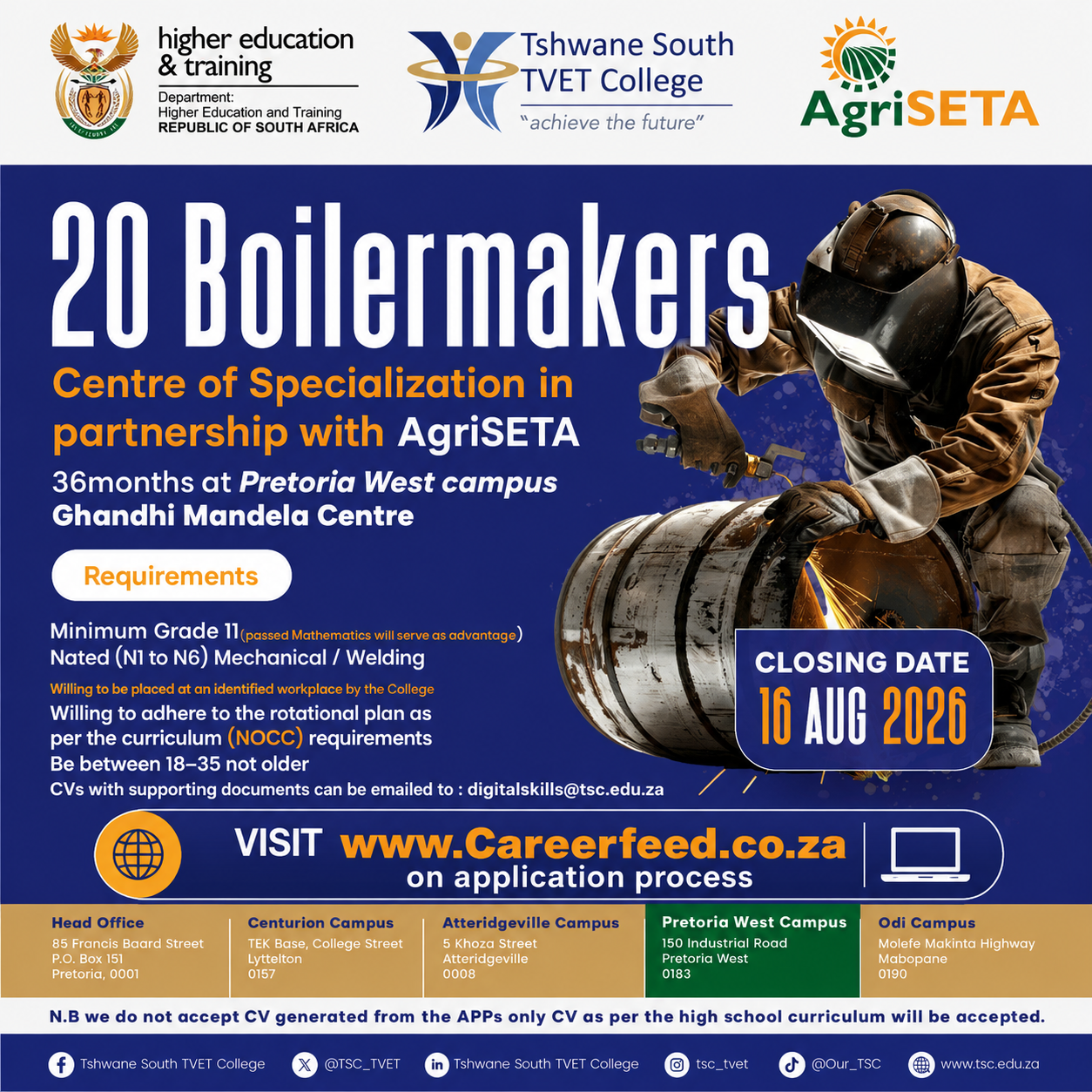
Tshwane South TVET College, in partnership with AgriSETA, is offering an exciting opportunity for young South Africans interested in developing Tshwane south practical skills in the engineering and manufacturing sector. Tshwane South programme is aimed at candidates who want to build a career as boilermakers while gaining structured training and workplace exposure.
According to tshwane south information displayed on the recruitment poster, the opportunity is for 20 Boilermakers and will run for 36 months at the Pretoria West Campus – Gandhi Mandela Centre. Tshwane south programme is presented through the Centre of Specialization and is designed to provide participants with technical knowledge and practical experience relevant to the boilermaking and welding environment.
For young people who enjoy working with their hands, machinery, metal fabrication and technical equipment, tshwane south opportunity may provide an important starting point towards a career in the engineering and industrial sectors.
About the Boilermaker Opportunity
Tshwane South Boilermaking is a skilled trade that plays an important role in many industries. Boilermakers work with metal components and equipment used in industrial, engineering, construction, manufacturing and related environments. Their work can involve fabrication, assembling, welding and working with technical drawings and industrial structures.
The Tshwane South TVET College opportunity is specifically focused on developing candidates in this field through a longer-term Tshwane South programme. Tshwane south advertised duration is 36 months, giving successful candidates an opportunity to develop their knowledge and practical abilities over an extended period.
Tshwane south programme is being offered in partnership with AgriSETA, while Tshwane South TVET College will facilitate the training environment. The involvement of a TVET college is particularly relevant because technical and vocational education is focused on equipping students with practical and occupational skills that can be applied in the workplace.
Participants should therefore understand that this is not simply an opportunity to submit a CV and immediately receive permanent employment. Candidates who are selected should be prepared to participate in training, follow the programme requirements and complete the practical components associated with their curriculum.
Where Will the Programme Take Place?
The poster states that the 36-month programme will be based at the Pretoria West Campus, Gandhi Mandela Centre.
Tshwane South TVET College has several campuses serving students and communities in the Tshwane area. The Pretoria West Campus is located at 150 Industrial Road, Pretoria West, 0183.
Applicants should carefully consider the location before applying. Candidates selected for the opportunity may be expected to attend training and participate in workplace-related activities according to the programme’s requirements.
Being able to attend the required training and workplace activities is therefore an important consideration for anyone interested in the opportunity.
Requirements for Applicants
The recruitment poster provides several requirements that prospective applicants should understand before submitting their applications.
The minimum academic requirement indicated is Grade 11. The poster also states that having passed Mathematics will serve as an advantage. This is particularly relevant for a technical field such as boilermaking, where learners may encounter measurements, calculations, technical information and engineering-related concepts during their training.
Applicants are also required to have a NATED qualification from N1 to N6 in Mechanical or Welding, according to the information shown on the poster. Candidates should therefore make sure that their qualifications and supporting documents match the requirements before applying.
Another requirement is that applicants must be willing to be placed at an identified workplace by the college. This is an important part of the opportunity because technical training can involve both classroom-based learning and practical exposure.
Candidates must also be willing to follow the rotational plan according to the curriculum and NOCC requirements. Applicants should understand that participation may therefore require flexibility and commitment to the programme schedule.
The poster further indicates an age requirement of 18 to 35 years.
Why Boilermaking Is an Important Skill
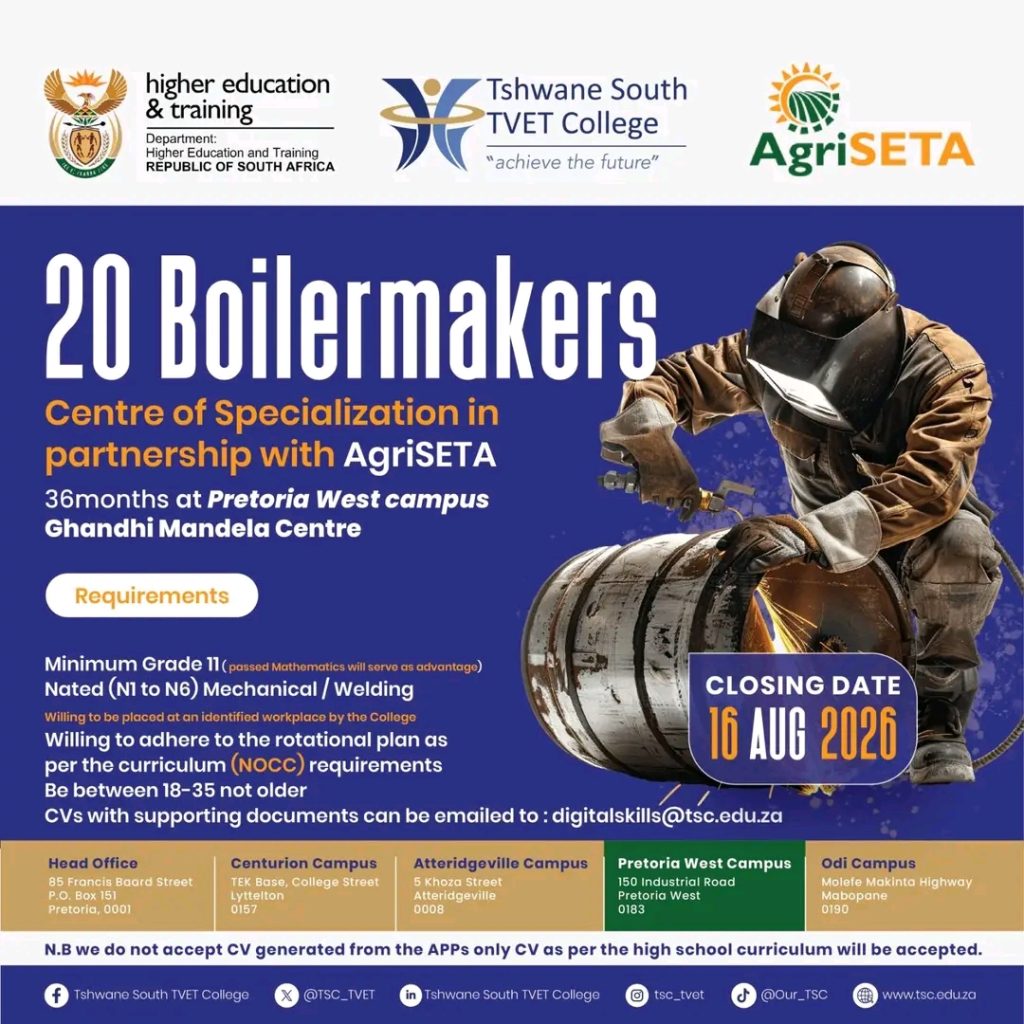
Boilermaking is a specialised trade that can be useful across different areas of the economy. Industries that depend on heavy machinery, metal structures, fabrication and industrial equipment require workers with appropriate technical skills.
A person trained in boilermaking may develop skills related to metal fabrication, welding, assembling components, reading technical information and using tools and equipment safely. These skills can be valuable in industrial and engineering environments.
For young people looking for a practical career rather than a purely office-based occupation, technical trades can provide an alternative pathway. A structured programme can also help learners understand workplace expectations, develop discipline and gain experience working in a professional environment.
However, success in a technical programme requires commitment. Applicants should be prepared to attend training, complete assignments and practical activities, follow safety instructions and work consistently throughout the programme.
Practical Training and Workplace Exposure
One of the notable features of the opportunity is the reference to workplace placement. The poster states that candidates must be willing to be placed at an identified workplace by the college.
Workplace exposure can be an important part of technical development because it allows learners to connect what they learn during training with practical situations. In an industrial environment, learners may have opportunities to observe how experienced workers approach tasks, understand workplace procedures and develop greater familiarity with professional equipment and processes.
Candidates should therefore approach the opportunity seriously. Workplace training comes with responsibilities, including punctuality, following instructions, respecting safety procedures and maintaining professional conduct.
Because boilermaking involves equipment, tools and industrial environments, safety should always be treated as a priority. Learners should follow all training instructions and workplace safety rules provided by their trainers and supervisors.
Documents and CV Submission
The poster states that CVs with supporting documents can be emailed to digitalskills@tsc.edu.za.
Applicants should make sure that their CV is accurate and that the information provided corresponds with their supporting documentation. Important information such as educational qualifications and relevant technical training should be clearly presented.
Applicants should also carefully check that their supporting documents are readable and complete before sending them. Missing documentation can create difficulties during the selection process.
The poster contains an important notice stating that CVs generated from apps will not be accepted and that only a CV prepared according to the high school curriculum will be accepted. Applicants should therefore pay close attention to this instruction when preparing their documents.
Rather than submitting random or incomplete information, candidates should ensure that their application is organised and presents their educational and technical background clearly.
Closing Date
The poster displays a closing date of 16 August 2026.
Applicants who are interested should avoid waiting until the last possible moment to prepare their documents. Preparing early gives candidates time to check their qualifications, organise supporting documents and make sure that the application is submitted through the indicated channel.
It is also advisable for applicants to carefully verify all application instructions before sending their documents. If an applicant is uncertain about a requirement, they should seek clarification from the relevant institution rather than making assumptions.
Application Information
The recruitment information includes an application email address for the submission of CVs and supporting documents: digitalskills@tsc.edu.za.
Applicants should use a clear subject line when sending an email and ensure that their documents are attached correctly. The email should contain professional and relevant information rather than unnecessary messages.
Candidates should also keep copies of the documents they submit for their own records.
For additional information about the tshwane South application process, applicants can visit https://careerfeed.co.za/and search for the relevant opportunity. Careerfeed can be used as an information resource for employment opportunities, learnerships and training opportunities advertised for South African job seekers.
Applicants should always rely on the official institution’s requirements and application instructions when completing an application.
Who Should Consider Applying?
This opportunity may be suitable for young South Africans who have an interest in technical trades, mechanical work, welding, metal fabrication and industrial careers.
It may particularly appeal to candidates who already have relevant NATED Mechanical or Welding training and meet the other requirements displayed on the poster.
Applicants should remember that meeting the minimum requirements does not automatically guarantee selection. Recruitment processes can involve screening and selection based on the information submitted by candidates.
Candidates should therefore make sure that their CVs and supporting documents accurately reflect their qualifications and experience.
A Possible Career Starting Point
For someone interested in becoming a skilled artisan, an opportunity such as this can represent an important step in developing occupational skills. Boilermaking requires technical knowledge, practical ability, attention to detail and a strong understanding of workplace safety.
The 36-month duration also means that successful participants should be prepared for a long-term commitment. Completing the programme requires persistence and willingness to learn.
Young people should not view technical training as simply a short-term opportunity. The skills developed through vocational education can contribute to longer-term career development when combined with further learning, workplace experience and professional development.
Final Thoughts
The Tshwane South TVET College 20 Boilermakers opportunity 2026, offered in partnership with AgriSETA, provides a pathway for eligible young people interested in developing technical skills in boilermaking, mechanical work and welding.
The programme is advertised as a 36-month opportunity at the Pretoria West Campus – Gandhi Mandela Centre. The stated requirements include a minimum of Grade 11, with passed Mathematics being an advantage, NATED N1 to N6 Mechanical or Welding, willingness to accept workplace placement, willingness to follow the required rotational plan and being between 18 and 35 years old.
Applicants should carefully prepare their CVs and supporting documents and follow the instructions provided by Tshwane South TVET College. The advertised closing date is 16 August 2026, so interested candidates should make sure that they do not leave their applications until the last minute.
For the application process and additional information, visit www.Careerfeed.co.za and look for the relevant Tshwane South TVET College Boilermaker opportunity.
Most importantly, prospective applicants should read all requirements carefully before applying, submit truthful information and ensure that their documents meet the instructions provided. A technical training opportunity can be a valuable foundation, but applicants must be ready to commit themselves to learning, practical training, workplace exposure and the responsibilities that come with developing a skilled trade.